Surreal boardroom of faceless directors ignoring a digital breach spreading across a cityscape, symbolizing failed cybersecurity oversight.

Data Proves Boards Are Failing at Cyber Oversight

Boards love to say they “take cyber seriously.” They add an IT committee, expand the board, schedule an annual cyber briefing, and proudly tell shareholders that the organization is “enhancing cyber oversight.” Yet breaches keep happening, regulatory expectations keep rising, and CISOs keep leaving. The problem isn’t a lack of structure.The problem is that structure […]

Data Proves Boards Are Failing at Cyber Oversight Read More »

One World, Many Rulebooks: Surviving Fragmented Cyber Compliance

Once upon a time, global cybersecurity compliance had the clean geometry of a well-drawn circuit.ISO 27001 was the north star, NIST SP 800-53 its American dialect, and SOC 2 the accountant’s accent that made it all sound legitimate.If your policies aligned and your audit passed, you could tell the board: we’re secure. That illusion has

One World, Many Rulebooks: Surviving Fragmented Cyber Compliance Read More »

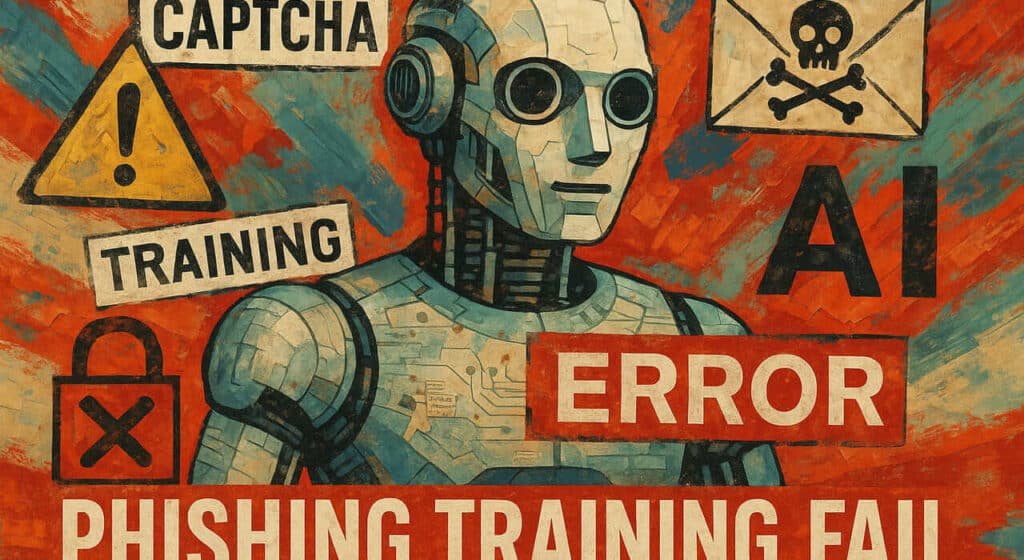
Editorial collage of a humanoid robot with newspaper textures and digital icons surrounded by words like “AI,” “Error,” and “Training,” symbolizing phishing awareness failure and cyber risk.

Click Fatigue: Why Phishing Training Fails (and What Cyber Risk Teams Should Do Instead)

The $10 Billion Illusion of Awareness Every year, enterprises pour billions into cybersecurity awareness and phishing simulations — posters in the hallway, inbox drills, gamified quizzes, and annual compliance refreshers.Yet, despite this massive investment, phishing remains the world’s most common initial attack vector. Two major peer-reviewed studies — one from IEEE Security & Privacy (Ho

Click Fatigue: Why Phishing Training Fails (and What Cyber Risk Teams Should Do Instead) Read More »

Why Financial AI Governance Needs a Global Risk Framework

The Fragmented Future of Financial AI From high-frequency trading to credit scoring and fraud detection, artificial intelligence (AI) is transforming the financial sector. Yet this transformation is unfolding faster than the regulatory frameworks meant to manage its risks. In regions like the EU, U.S., and China, policymakers have launched vastly different approaches to AI governance

Why Financial AI Governance Needs a Global Risk Framework Read More »

Generative AI in Finance: 2025 Playbook From The Swiss Bankers Association

TL;DR — Generative AI (GenAI) can drive real gains in productivity, operational efficiency, customer satisfaction, and financial product innovation for Swiss banks. But the benefits only materialize if deployments follow strict legal, compliance, and governance rules: FADP/FDPIC transparency, Banking Secrecy (BA Art. 47), Unfair Competition Act safeguards, FINMA Guidance 08/2024 governance & monitoring expectations, and—for

Generative AI in Finance: 2025 Playbook From The Swiss Bankers Association Read More »

Banking on Trust: Adversarial Machine Learning and the Future of Bank Security

The banking industry has always been built on trust. Vaults, compliance checks, and sophisticated risk frameworks reassure customers that their money—and their data—are safe. But a new and less visible threat is quietly emerging. It doesn’t wear a mask or crack safes. It manipulates machine learning models, the very engines behind fraud detection, credit scoring,

Banking on Trust: Adversarial Machine Learning and the Future of Bank Security Read More »

Street art of a humanoid robot in red, orange, and yellow tones, inspired by First Hawaiian Bank’s branding, symbolizing AI governance in future banking

AI in Banking 2025: What Bank Executives Need to Know About AI Governance & Risk

Boardrooms Under AI Scrutiny The conference room at Atlantic Trust Bank was cavernous, a relic of a more opulent era. Thick walnut paneling, brass sconces, and a table that could seat twenty-five—though today, only twelve sat around it, shifting in tailored silence. On the screen: a single line. “78% of companies now use AI in

AI in Banking 2025: What Bank Executives Need to Know About AI Governance & Risk Read More »

Explainable AI in Finance: The Definitive Playbook for 2025 (Compliance, Trust, and ROI)

Explainable AI in Finance: A Strategic, Compliance‑First Playbook Artificial Intelligence (AI) is reshaping finance. Yet its opaque “black boxes” raise serious concerns in high‑stakes domains like credit, trading, fraud detection, and risk compliance. Explainable AI (XAI), also called interpretable or transparent AI, promises to unlock trust, performance, and regulatory alignment when implemented correctly. Why XAI

Explainable AI in Finance: The Definitive Playbook for 2025 (Compliance, Trust, and ROI) Read More »

A dramatic oil painting of a Zurich data hall flooding under storm clouds, as executives look on from above. Dimming terminals and rising water reflect the failure of misaligned governance frameworks, with cracked compliance symbols dissolving in the sky.

Future‑Proof GRC: Aligning Framework Choice with Business‑Continuity Objectives

1 Monsoon Midnight: A Zurich Data‑Hall Goes Under A rogue summer storm ruptures the riverbank; water pours through a Tier III colocation site. By sunrise, a mid‑tier bank’s trading book is stranded in read‑only mode and the CFO is on CNBC explaining why her “redundant” controls drowned. The anecdote frames a single question for every director watching

Future‑Proof GRC: Aligning Framework Choice with Business‑Continuity Objectives Read More »