
InfoSecured / Using our resources
Terms of Service
These Terms of Service explain how you may use InfoSecured’s website and resources, what requires permission, and the responsibilities that come with applying them in your own work.
Terms of Service at a glance
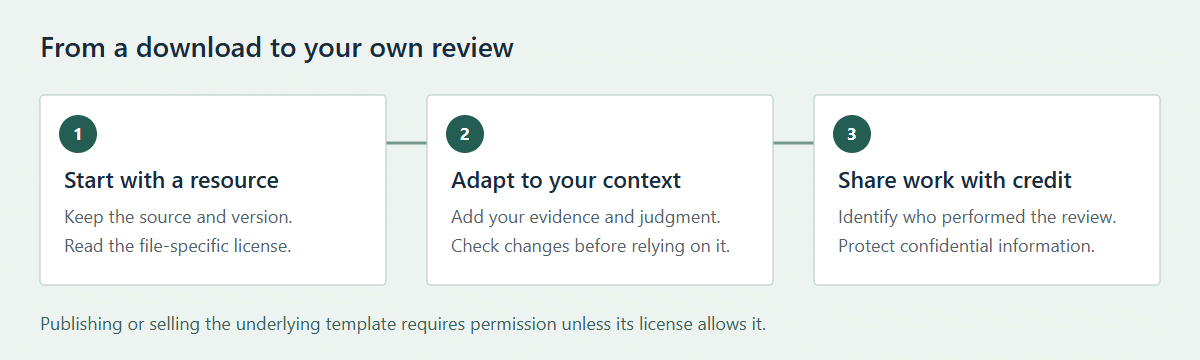
Our resources are designed to support learning and practical professional work. You may adapt a template to your review, preserve its source attribution, and share completed work with appropriate reviewers. Check the detailed permissions below and any license supplied with the specific file.
1. Scope of these Terms of Service
InfoSecured publishes resources about AI governance, risk, security and assurance. “InfoSecured,” “we,” “us” and “our” refer to the independent operator of infosecured.ai. These Terms of Service cover the website, articles, diagrams, templates, workbooks and other resources we make available.
Read these terms before adapting or redistributing a resource. If you do not accept the conditions attached to our permission, do not use the resource under that permission. A clearly identified license accompanying a specific resource controls that resource’s permitted uses where it differs from this notice. A separate written engagement governs any separately agreed services.
These Terms of Service do not remove rights you have under applicable law. A download, subscription or inquiry does not establish a professional engagement, confidentiality agreement or commitment to provide ongoing support.
2. Template permissions under these Terms of Service
Unless an accompanying license states otherwise, we grant a non-exclusive permission to download, copy and adapt our publicly available templates and workbooks for the following purposes, subject to these Terms of Service:
- Learning and evaluation: study a method, test a workflow, develop skills or prepare for an assessment.
- Internal professional use: support your organization’s governance, risk, assurance, security, audit preparation or review activities, including work within a commercial organization.
- Training and portfolio work: use an adapted example to explain your method and demonstrate work you performed. Clearly identify example information and your own contribution.
- Review and reporting: share completed records or relevant extracts with colleagues and authorized reviewers involved in your assessment, subject to confidentiality and data-handling requirements.
Keep relevant source and license notices. Label material changes, and do not imply that InfoSecured performed, verified or endorsed your assessment. Our permission covers rights we can grant in our own material; it does not grant rights to third-party text, software, standards or datasets.
Example: a completed assurance review
You may adapt a workbook for your organization, add evidence and findings, and share the completed review with its authorized decision-makers. Keep the resource attribution and make clear who performed the review. That use does not require selling or republishing the blank template.
3. Attribution, ownership and redistribution
InfoSecured or the relevant rights holder retains rights in original text, illustrations, templates and other protected material. We do not claim ownership of public facts, underlying ideas, laws, third-party standards or your independently created information.
You retain any rights you hold in records, findings and original content you add. Adapting a resource does not transfer ownership of its original protected material to you. An attribution such as “Adapted from InfoSecured’s [resource title], version [number], infosecured.ai; modified by [reviewer or organization]” helps distinguish the source from your work.
Unless a specific license permits it or applicable law allows it, obtain written permission before selling or sublicensing our materials, publicly redistributing a complete template, translating and publishing a resource, or incorporating substantial material into a template marketplace, competing library or commercial product. Do not present the original resource as entirely your own work or use our name or logo to suggest approval.
Linking to a public resource page is welcome. For uses beyond these Terms of Service, describe the material, audience and planned distribution through the Contact page. Statutory exceptions remain available; the U.S. Copyright Office’s fair use guidance explains the US framework.
4. Professional use under these Terms of Service
A template organizes a review; the evidence, interpretation and decision belong to the people performing it. Check the relevant law, source version, organizational policies, system scope and acceptance criteria. Test calculations and any changes before relying on a working file.
Our general publications are not individualized legal, financial or other professional advice, an audit opinion, certification, regulatory approval or model-validation result. They do not guarantee compliance, control effectiveness, security or a favorable review outcome. Use appropriately qualified reviewers where the activity requires them.
In AML, financial crime and other regulated work, a resource supports documentation and analysis. It does not perform required due diligence, transaction monitoring, suspicious activity decisions, reporting or organizational approval on your behalf. Your organization remains responsible for its obligations and decisions.
5. Acceptable use of the website
Use the website lawfully and respect other people’s rights. These Terms of Service prohibit:
- Fraudulent or misleading use, including presenting our resources as an approval, credential or assessment we issued.
- Unauthorized access, exploitation of vulnerabilities, interference with access controls, or activity that disrupts or overloads the site.
- Uploading malicious material or submitting personal, confidential or proprietary information you are not entitled to disclose.
- Copying or distributing protected material beyond the permission provided here, a specific license or applicable law.
Ordinary search indexing and reasonable automated access to public pages are permitted, subject to applicable law, published access rules and reasonable request rates. Automated access does not grant permission to republish protected content. Do not bypass restrictions or access non-public areas.
We may limit access reasonably needed to address misuse, security risks or legal requirements. A restriction on website access does not, by itself, cancel permissions previously granted for a lawfully obtained resource; a material breach of its license conditions may affect those permissions.
6. Messages, subscriptions and privacy
The Privacy Policy describes website information practices and privacy choices. These Terms of Service do not substitute for consent where consent is required.
Send only the information needed for an inquiry. Do not send passwords, identity documents, customer transaction records, legally privileged information or confidential organizational evidence through a general contact route. Arrange an appropriate channel and any necessary agreement before sharing sensitive material.
We do not acquire ownership of your message or permission to publish it merely because you contact us. Personal information is handled as described in the Privacy Policy and applicable law.
If email subscriptions are offered, enrollment must be a separate choice. Reading an article or downloading a publicly linked workbook does not enroll you. Subscription emails provide a way to unsubscribe.
7. Sources, external links and demonstrations
References to research, regulations and standards provide context. Review the original source and its current status when applying it. A citation does not imply affiliation with, approval by or endorsement from its author, publisher or regulator.
External websites and services operate under their own terms and privacy practices. We do not control their content, availability or subsequent changes. Third-party materials retain their own rights and license conditions.
Where a resource is expressly labeled a prototype, demonstration or fictional example, interpret it within that stated scope. A demonstration does not establish that a product is deployed, supported or available for purchase. File-specific release notes and instructions explain the status of a particular resource.
8. Availability, warranties and liability
We may correct, update, replace or withdraw public content and downloads. Keep a record of the resource version used in a review. Website access does not include a guaranteed service level, indefinite hosting of a particular version or an ongoing support commitment.
To the extent permitted by applicable law, free website content and resources are provided “as is” and “as available,” without warranties of accuracy, completeness, uninterrupted availability or suitability for a particular purpose. This does not alter an express obligation in a separate written agreement.
To the extent permitted by applicable law, InfoSecured is not liable for indirect or consequential losses arising from use of the free website or resources, including lost profits or business interruption. We do not exclude liability for fraud, intentional misconduct or any liability that cannot lawfully be excluded or limited. Mandatory consumer rights and other non-waivable protections remain intact.
9. Changes to these Terms of Service and disputes
Updates to these Terms of Service appear on this page with a revised date. Material changes affecting an active service or requiring specific notice or agreement will be communicated as required. A revised notice does not retroactively remove permissions already granted under an earlier resource license.
Questions or disputes may be raised through the Contact page. Applicable law determines the competent courts and any mandatory rights available to you. Contacting us does not prevent you from using legal remedies available under that law.
If a provision is invalid or unenforceable, the remaining provisions continue only to the extent permitted by law. These Terms of Service, any applicable resource license and any separate written agreement address their respective scopes; a specific resource license controls its use permissions.
10. Questions about these Terms of Service
For a permission request under these Terms of Service, identify the resource and version, what you want to do with it, and whether it will be distributed publicly or sold. For a correction or access problem, include the affected page or file and a concise description.
Contact InfoSecured
Start your message with “Terms” or “Permission” so the request can be identified.
Go to the Contact page