AI Definitions

End-to-End Learning (E2E): Streamlining AI to Master Complex Tasks

Traditional AI models often rely on several stages to complete a task—each requiring separate training, fine-tuning, and optimization. But what if a single model could handle everything from start to finish? End-to-End Learning (E2E) does exactly that, training a model to solve tasks autonomously without breaking them down into sequential steps. What Is End-to-End Learning? […]

End-to-End Learning (E2E): Streamlining AI to Master Complex Tasks Read More »

Dimensionality Reduction: Simplifying Data for Superior AI Model Performance

As machine learning models become more complex and datasets grow larger, the importance of dimensionality reduction has skyrocketed. It’s no longer just a technical buzzword but a crucial step that makes or breaks the efficiency of AI systems. Dimensionality reduction, at its core, is about cutting down the number of features in a dataset—removing irrelevant

Dimensionality Reduction: Simplifying Data for Superior AI Model Performance Read More »

Diffusion machine learning process, AI noise recovery techniques

Diffusion For Noise Management and Data Recovery

When training artificial intelligence (AI) models, noise is often viewed as a challenge that corrupts data and interferes with model accuracy. However, diffusion—a process that adds intentional noise to data during training—flips this assumption. By training models to reverse the noise and reconstruct the original data, diffusion enhances their ability to work with imperfect or

Diffusion For Noise Management and Data Recovery Read More »

Cartoon-style illustration featuring an AI robot humorously studying complex diagrams. Deep Learning: Simulating Human Brain Function Through Artificial Neural Networks

Deep Learning: Simulating Human Brain Function Through Artificial Neural Networks

Table of Contents 1. Introduction Deep learning is revolutionizing the way machines learn, allowing them to recognize intricate patterns and make intelligent decisions based on data. Taking inspiration from the human brain, deep learning harnesses the power of artificial neural networks to solve complex problems and extract valuable insights that were once out of reach.

Deep Learning: Simulating Human Brain Function Through Artificial Neural Networks Read More »

Data Preprocessing: How to Clean and Organize Raw Data for Accurate AI Models

Think about trying to solve a complex puzzle with missing, distorted, or incomplete pieces. It wouldn’t be easy, right? That’s exactly what happens when machine learning models are fed raw, unprocessed data. This is where data preprocessing steps in—a vital process that transforms unstructured, messy data into a clean, usable format, ensuring that AI models

Data Preprocessing: How to Clean and Organize Raw Data for Accurate AI Models Read More »

Example of data augmentation techniques applied to image recognition tasks in AI - in the form of a DJ cat with many arms (AI generated)

Data Augmentation: Enhance AI Training by Remixing Data for Better Performance

Data is at the heart of everything AI does. Whether it’s recognizing objects in photos or understanding human speech, AI relies on vast amounts of high-quality data. But here’s the catch: real-world data is often messy, expensive to collect, and sometimes just not enough. That’s where data augmentation comes in—a technique that effectively “remixes” existing

Data Augmentation: Enhance AI Training by Remixing Data for Better Performance Read More »

Cartoonish robot using active learning to label data points, surrounded by graphs and data visualizations, representing the efficient training process in AI.

Active Learning: How AI Gets Smarter by Asking the Right Questions

Training AI models often requires massive amounts of labeled data, which can be both time-consuming and expensive. But what if there was a way to make the process more efficient without sacrificing accuracy? Enter Active Learning—a game-changing approach that allows models to improve by strategically selecting the most useful data for training. In this article,

Active Learning: How AI Gets Smarter by Asking the Right Questions Read More »

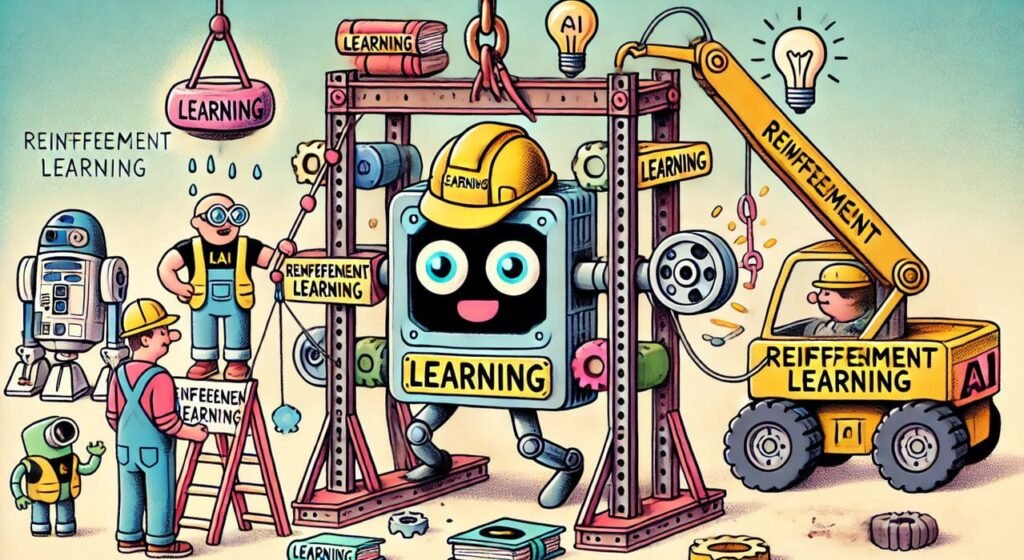
AI agent using Reinforcement Learning to interact with an environment, demonstrated through a cartoon construction site.

Reinforcement Learning: Unlocking AI’s Adaptive Power | InfoSecured.ai

Reinforcement Learning (RL) is a powerful machine learning paradigm, and its potential is increasingly being recognized across diverse fields, from gaming to healthcare. At its core, RL involves an agent learning to make decisions through interaction with an environment, receiving feedback in the form of rewards or penalties. The agent’s objective is to maximize the

Reinforcement Learning: Unlocking AI’s Adaptive Power | InfoSecured.ai Read More »

Visual representation of anomaly detecting AI robot using machine learning, highlighting its role in fraud prevention and cybersecurity.

Anomaly Detection in AI: How Machine Learning Identifies Unusual Patterns

Imagine an AI system that can instantly flag unusual credit card transactions, detect early signs of equipment failure, or identify a cybersecurity breach before it happens. That’s the power of Anomaly Detection—a vital tool in the machine learning arsenal that helps sift through massive amounts of data to pinpoint the outliers. In this article, we’ll

Anomaly Detection in AI: How Machine Learning Identifies Unusual Patterns Read More »